
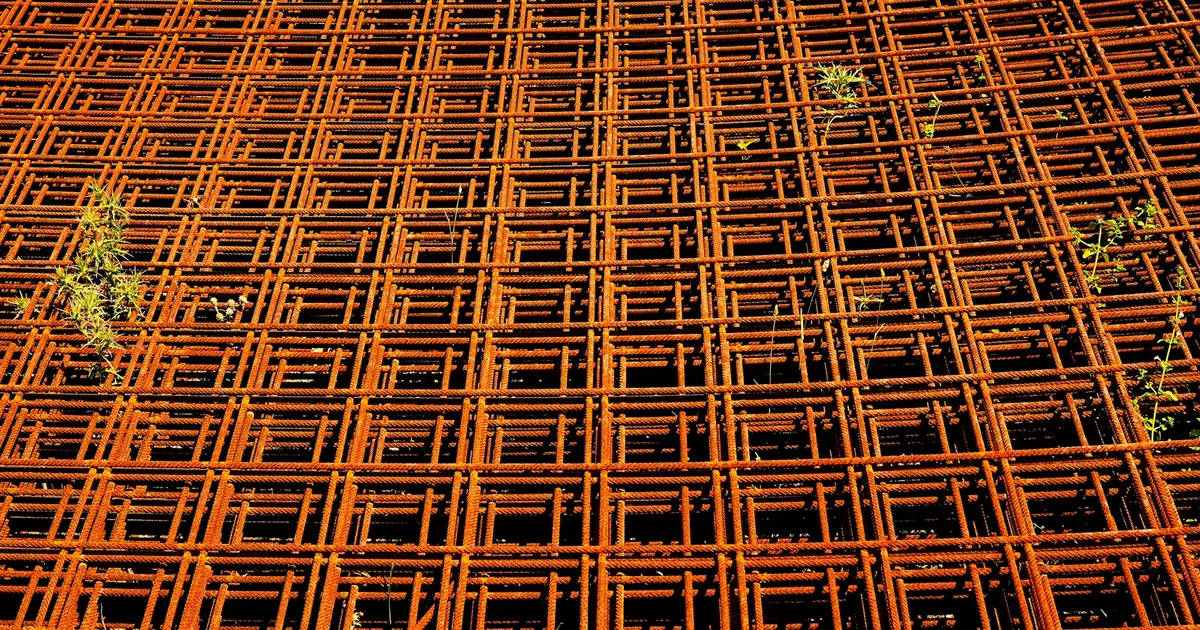
Welded wire mesh is a ready-made reinforcement grid produced by welding reinforcement bars to one another at their intersections. It is also known as mesh reinforcement or reinforcing fabric.
Its main purpose is to cut labour on site: instead of cutting and tying bars individually, a ready grid is laid. It is widely used in concrete slabs, industrial floor slabs and shear walls.
Square and rectangular types
Mesh types are distinguished by how much reinforcement runs in each direction. That distinction determines the direction in which the mesh carries load.
| Square type | Equal reinforcement in both directions; for two-way spanning slabs |
|---|---|
| Rectangular type | Heavier reinforcement in one direction; for one-way spanning slabs |
| Spacing | Commonly 15x15 cm and 15x25 cm |
| Bar diameter | Set by the design; larger for walls than for thin slabs |
Standard sizes
Mesh is produced as sheets or in rolls. Sheet mesh has settled on established market sizes; other dimensions can be produced to order where the design requires it.
Two things drive the choice of size: the slab dimensions and the lap allowance. Sheets are overlapped by a set distance where they meet; if that allowance is left out of the take-off, the site ends up short of reinforcement.
Where it is used
- Reinforced concrete slabs and foundations
- Industrial and external floor slabs
- Shear wall reinforcement
- Retaining walls and screed
- Precast element production
Compared with loose bar
The same amount of reinforcement can be provided with loose bar. The difference lies in labour and consistency: in mesh the spacing is fixed at the factory, the risk of tying errors falls and laying is fast.
Loose bar is still needed for complex geometry and heavily reinforced work. In practice the two are often used together.
Storage and corrosion
Mesh left in the open develops surface rust. A thin surface film does not harm the bond with concrete; flaking rust that reduces the bar section is not acceptable.
Mesh should therefore be stacked clear of the ground, where water does not collect, and covered where possible.