
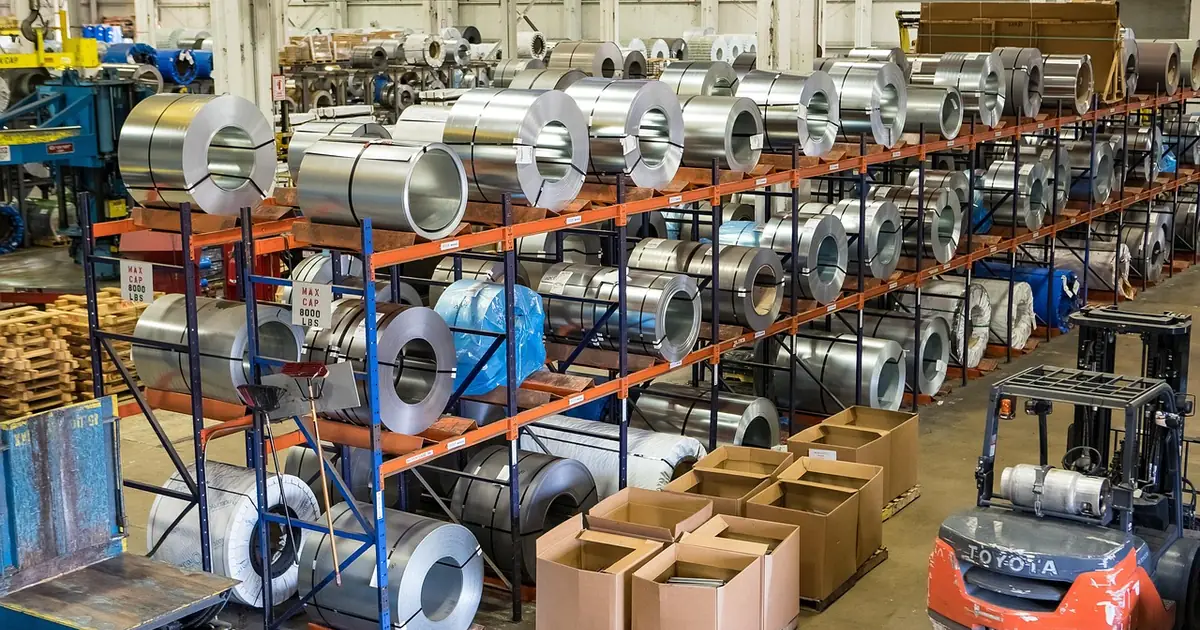
A bonded warehouse is a place where imported goods are stored under the supervision of the customs administration without customs duties being paid. While in the warehouse the goods are not treated as being in free circulation; the duty liability arises only when the goods are withdrawn and an import declaration is filed.
In practical terms this means an importer who cannot sell the goods or put them into production straight away can hold them without tying up capital in duty. It is the most widely used solution in high-tonnage steel, raw material and machinery imports.
The difference between a bonded warehouse and an ordinary warehouse
The fundamental difference is customs supervision. Goods you put in an ordinary warehouse have already had their duty paid and are in free circulation; you can take, sell or move them whenever you like. Goods entering a bonded warehouse are treated as not yet subject to duty and cannot be taken out without the permission of the customs administration.
That is why a bonded warehouse offers two things an ordinary warehouse does not: deferral of duty, and the goods remaining legally "not imported". In return, it is subject to a regime of records, declarations and seals.
| Customs supervision | Present in a bonded warehouse, absent in an ordinary one |
|---|---|
| Duty | Deferred until withdrawal in a warehouse; paid up front in an ordinary depot |
| Withdrawal | Subject to customs permission; free in an ordinary depot |
| Record-keeping | An inbound–outbound register is compulsory in a warehouse |
| Operations | Only handling in a warehouse; unrestricted in an ordinary depot |
How long can goods stay in a bonded warehouse
There is no time limit on staying under the warehousing procedure. However, once a declaration is registered for another customs procedure, the formalities must be completed within 30 days (Customs Regulation art. 389).
The administration may set a specific time limit in cases such as perishable goods. That is why it matters to state the type of goods from the outset; any deadline risk is then seen in advance.
Which operations can be carried out in a bonded warehouse
Handling operations that do not change the nature of the goods can be carried out in a bonded warehouse. Permission is obtained from the customs administration for them.
- Sorting — splitting a consignment by buyer or by type
- Weighing, counting and measuring
- Labelling and repacking
- Sampling and quality control
- Renewing packaging and operations for protection
Manufacturing operations that change the nature of the goods cannot be carried out under the warehousing procedure. If production is intended, another structure such as inward processing or a free zone has to be considered.
Partial withdrawal: the most used advantage of a bonded warehouse
You do not have to withdraw all the goods in the warehouse at once. You withdraw as much as you have sold or will put into production and pay duty only on that part; the remainder stays in the warehouse.
On high-tonnage shipments this is the feature that eases cash flow the most. Instead of paying the duty on a 500-tonne consignment up front, you pay the duty on the 80 tonnes you process that month.
What determines the cost of a bonded warehouse
The storage charge depends on three variables: the type of goods, the area they occupy or their tonnage, and the length of stay. Handling, loading and unloading and any additional operation charges are added to that.
A price given without knowing these three variables is not binding. A serious operator shows separately in the quotation what each item costs.